
Driveways and garage aprons
Sunken sections near the garage or the street can be raised so cars and water move the right way again.
Concrete leveling
Sunken driveway, walkway, or patio? We lift it back into place with foam or slurry instead of tearing it out.
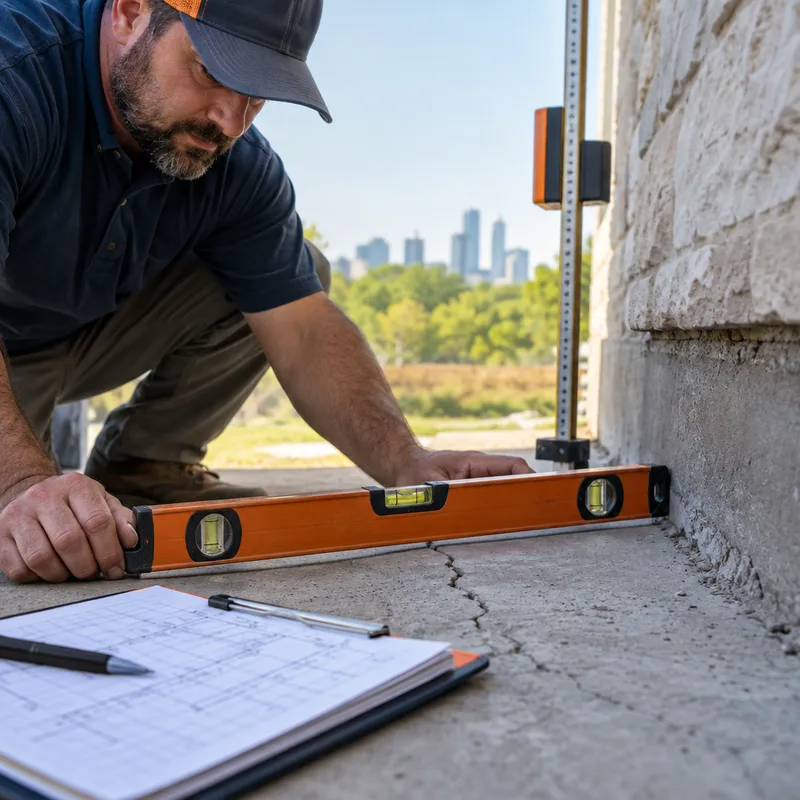
When a section of driveway, sidewalk, or patio sinks, you usually do not need to tear it out. Concrete leveling lifts the existing slab back toward its original height by filling the empty space underneath it, then the small access holes are patched.
We do it two ways: foam leveling, which uses expanding polyurethane, and mudjacking, which uses a cement-based slurry. Both lift concrete that has settled but is still in one piece. Lifting usually costs less and causes less disruption than removing the slab and pouring new concrete.
Concrete leveling is separate from foundation work on the house itself, but it often comes from the same causes: soil that shrinks in dry spells, runoff washing soil away, and fill that settles. If the house is moving too, our foundation repair work in Austin covers that side.
Signs it is time to level concrete:
Most flatwork around a house can be lifted if it is still in one piece.
Sunken sections near the garage or the street can be raised so cars and water move the right way again.
Lifting the low panel removes the trip edge without replacing the whole walk.
Restoring the slope away from the house keeps rain from running back toward the foundation.
Settled porch slabs and garage floors can be raised and the gap at the house sealed afterward.
Both methods lift sunken concrete. The difference is the material pumped underneath and the size of the holes needed:
We recommend one or the other after we look at the slab, the soil underneath, and how big the empty space is. You get the reason for the choice in writing.
We measure how far the concrete has dropped, check for cracks through the slab, and look at what washed out or compressed the soil.
Small holes are drilled in a planned pattern, and the foam or slurry is injected slowly so the slab rises evenly.
The holes are filled and the work area is cleaned. Patches may show slightly against older concrete.
If runoff caused the settling, we point out downspout, grading, or joint-sealing fixes that help keep the slab in place.
Every job is priced after we see it. The main things that change the cost:
You get the price in writing before any work starts.
Neither is better for every slab. Foam is lighter and uses smaller holes; slurry is a long-proven way to fill larger voids. We recommend the one that fits your slab and explain why.
If the slab is broken into many pieces or crumbling, replacement is usually the better value. We will tell you honestly after we look at it.
No. Concrete leveling is for driveways, walkways, patios, and other flatwork. If the house itself is settling, that calls for foundation leveling or piers.
Yes. We work across Austin and in those nearby communities.
Call (737) 245-0220. Tell us what has sunk and where, and we will set up a time to look at it and give you a written price.
Where we work
We level concrete across Austin and in nearby Lakeway, West Lake Hills, and Bee Cave.
Tell us which concrete has settled and how much. We will look at it, explain the best way to lift it, and give you a written price.