
Driveways and aprons
Sunken sections, especially where the driveway meets the garage or the street, can be raised so cars and water flow the right way again.
Mudjacking
Sunken driveway, walkway, or patio? Mudjacking lifts the concrete back into place without tearing it out and pouring new.
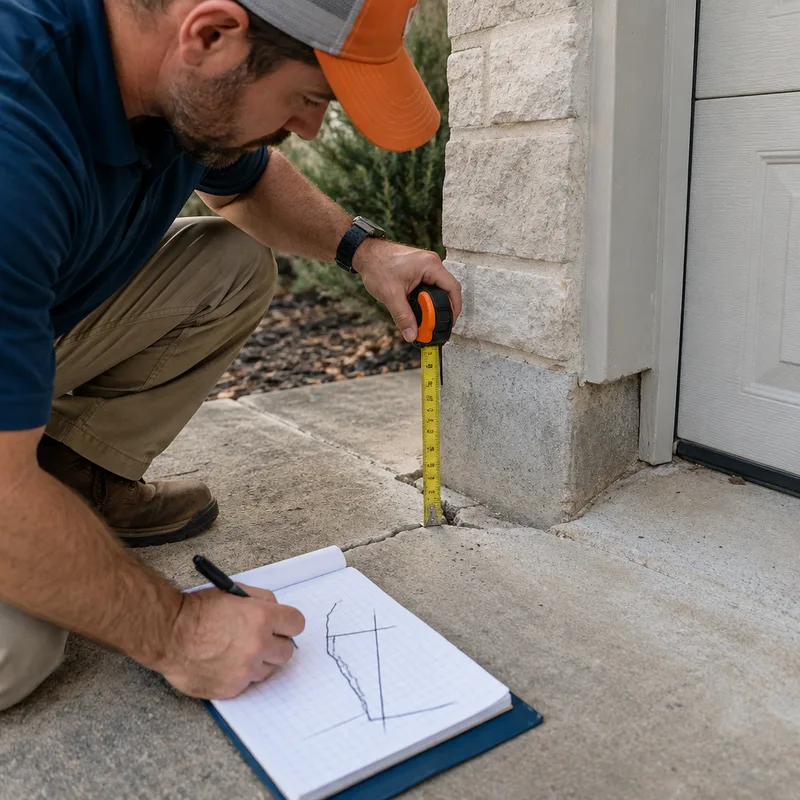
Mudjacking, also called slab jacking, lifts sunken concrete by pumping a cement-based slurry underneath it. Small holes are drilled through the slab, the slurry fills the empty space below, and the pressure raises the concrete back toward its original level. The holes are then patched.
It is a practical fix for concrete that has dropped but is still in one piece: driveways, walkways, patios, porch slabs, steps, pool decks, and garage floors. Lifting the slab you already have usually costs less and causes less disruption than tearing it out and pouring new concrete.
Around Austin, the usual causes are soil that shrinks during long dry spells, runoff that washes soil out from under the edge of a slab, and fill soil that settles over time. We offer mudjacking alongside our foundation repair work, so we can also tell you if the problem goes beyond the flatwork.
Signs a slab may be a good candidate:
Mudjacking works on flatwork that has settled as one piece. These are the jobs it is used for most:
Sunken sections, especially where the driveway meets the garage or the street, can be raised so cars and water flow the right way again.
Trip edges between sidewalk panels are a safety problem. Lifting the low panel removes the edge without replacing the walk.
When a patio tips toward the house, rain runs straight at the foundation. Lifting it restores the slope away from the home.
Porch slabs and garage floors that have settled can be raised and the gap at the house sealed once the slab is back in place.
Lifting a slab only works when the concrete and the cause allow it. We will tell you if another approach makes more sense, for example:
We also offer foam leveling, which lifts the slab with expanding polyurethane instead of a cement slurry. Both work; which one fits depends on the slab, the soil, and the size of the void. See our concrete leveling page to compare them.
We look at how far the concrete has dropped, whether it is cracked through, and what washed out or compressed the soil underneath.
Small holes are drilled in a planned pattern, and slurry is pumped in slowly so the slab rises evenly instead of cracking.
The holes are filled with grout and the work area is cleaned. Expect the patches to show slightly against older concrete.
If runoff caused the settling, we point out downspout, grading, or joint-sealing fixes that help keep the slab where it is.
Every job is priced after we see it, because the cost depends on a few things that vary a lot from slab to slab:
You get the price in writing before any work starts.
It depends mostly on the soil and water under the slab. When the drainage problem that caused the settling is fixed, a lifted slab can stay in place for years. If water keeps washing soil away, it can settle again.
Mudjacking is mainly for driveways, walkways, patios, and other flatwork. A house slab that is settling usually needs piers or other leveling methods, which we can inspect and quote separately.
A little. The holes are filled with cement grout, which may not match older, weathered concrete exactly.
We will tell you how long to stay off it for your specific job. It is much sooner than with new concrete, which needs days to cure.
Call (737) 245-0220. Tell us what has sunk and where, and we will set up a time to look at it and give you a written price.
Where we work
We lift sunken concrete across Austin and in nearby Lakeway, West Lake Hills, and Bee Cave.
Tell us which concrete has settled and how much. We will look at it, explain whether mudjacking is the right fix, and give you a written price.