
Perimeter piers
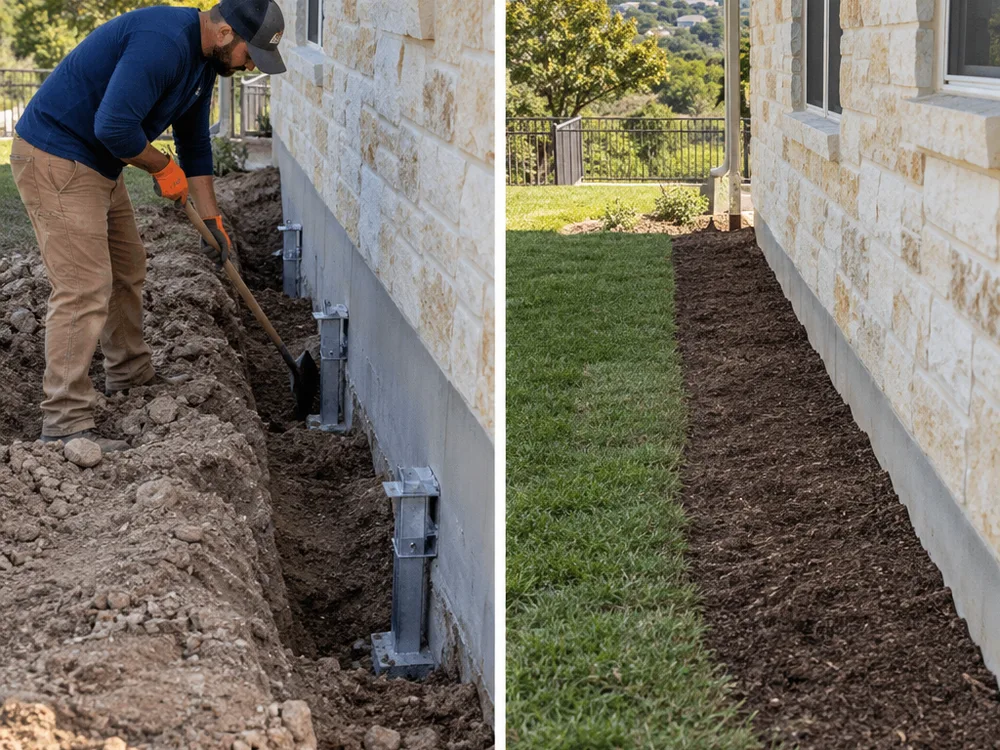
Piers placed along the outside edge of the slab carry the load down to more stable ground and can lift low corners back toward level.
Slab foundations
Sloping floors, cracked tile, or doors that stick? We find where the slab is moving and give you a written repair plan.
Most newer homes here are built slab-on-grade: the house sits on a concrete slab poured directly on the ground. When part of the ground under that slab swells, shrinks, or washes out, the slab moves with it, and the house shows it as cracks, sloping floors, and doors that no longer close right.
Why slabs move depends on where you live. East of I-35, much of Austin sits on deep clay that shrinks and swells as it dries out and gets wet. West of the highway, the soil is often thin over limestone, and problems tend to come from how the lot was graded and drained, or from fill that settled. Plumbing leaks under a slab can also soften the soil, so we recommend a licensed plumber test when the signs point that way.
Slab repair is one part of the foundation repair in Austin we handle, so we can tell you whether you need piers, leveling, drainage changes, or just monitoring.
Common signs of slab movement:
The method depends on what is moving and why. After we measure the floor elevations, we recommend the least disruptive repair that will hold.
Piers placed along the outside edge of the slab carry the load down to more stable ground and can lift low corners back toward level.
When the middle of the slab has dropped, interior support points may be needed. We explain access before any work starts.
Where part of the slab has lost support from a void underneath, filling and stabilizing that area can reduce deflection and cracking.
Downspout extensions, grading, and keeping water away from the slab edge help the repair last through wet and dry seasons.
Many slabs have steel cables under tension inside the concrete. We identify the slab type before drilling or cutting, because cutting a cable is dangerous and costly.
Slab repair typically ranges from about $2,500 to $15,000+, with small stabilization or targeted work at the lower end and larger pier scopes at the higher end.
Your price depends on how many support points are needed, whether interior piers are required, access around the house, and whether drainage corrections are included. The exact cost is confirmed after an on-site inspection and a written scope.
Not always. Hairline cracks are common in concrete. Cracks that widen, show one side higher than the other, or come with sloping floors and sticking doors are worth an inspection with elevation readings.
Sometimes. Interior support points may need access through the floor, and some can be reached from outside. We explain the access plan before any work starts.
If there are signs of a leak, such as a high water bill, damp flooring, or movement near plumbing runs, a licensed plumber test is a good first step so the repair is not undermined by a leak.
Many repairs take one to three days on site, depending on access and the number of support points. Larger scopes take longer.
Call (737) 245-0220. We will set up a time to measure the floors, explain what we find, and give you a written scope.
Where we work
We repair slab foundations across Austin and in nearby Lakeway, West Lake Hills, and Bee Cave.
Tell us what you are seeing and when it started. We will measure the floors, explain the cause, and give you a written repair plan.